
Reflections on the NYC Earth Room
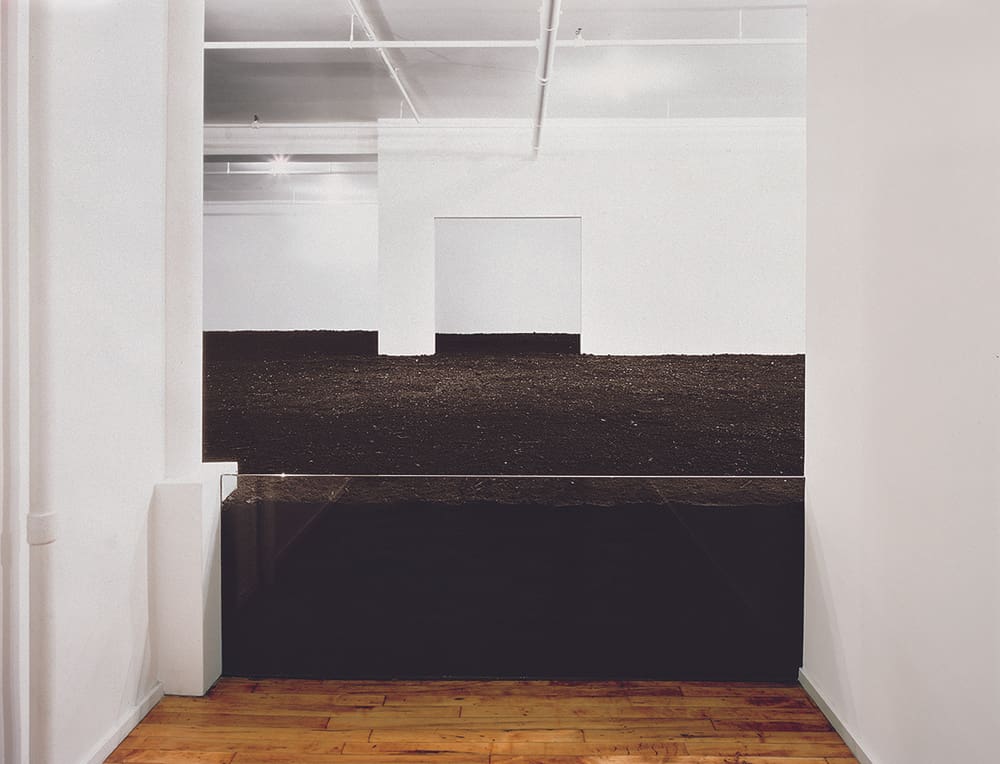
The New York City Earth room is an interior sculpture exhibit like no other you have seen before. This sculpture was produced in 1977 by the artist Walter de Maria and is located at 141 Wooster Street in the upscale art and shopping district of Soho in Manhattan. It contains 250 cubic yards of earth in a 3,600 square foot floor space. The soil depth is 22 inches and the total weight of this sculpture is 280,000 pounds. The composition is of peat bark and earth, transported by Cityscape Landscaping. The artist produced two other earth rooms in Germany in 1968 and 1974 but only the New York City earth room is still in existence and open to the public. Walter de Maria’s work explores the relationship between art and the natural environment. This installation is owned and maintained by the Dia Art Foundation. The sculpture was first described as “a minimal, interior, horizontal earth sculpture” – a fact-based aesthetic (Artforum, 2023).
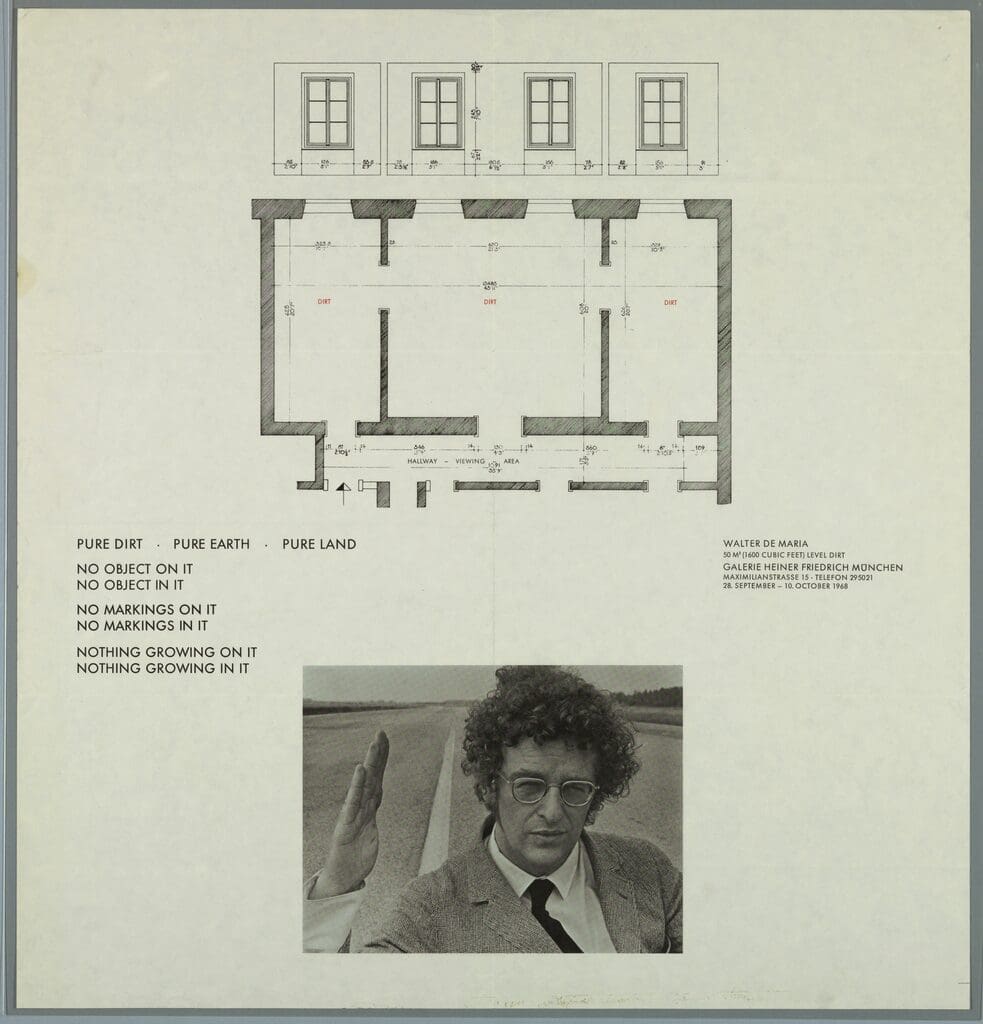
The Munich Earth room had a description that includes “pure dirt/pure earth/pure land” – see the figure below. For the Munich press release, Walter de Maria famously stated: “THE DIRT (OR EARTH) IS THERE NOT ONLY TO BE SEEN BUT TO BE THOUGHT ABOUT!” By the time Walter de Maria designed the New York City earth room, he made the experience direct and unmediated without any verbal direction or explanation.
As someone who works with soil and thinks deeply about it, seeing an indoor display of soil as art was a very different experience from seeing soil in a landscape or wilderness area. This display of soil as art requires quiet contemplation and ideally time to fully absorb.
The three earth rooms exemplified the unique, organic aesthetic that characterized Walter de Maria’s career as well as the broader Land Art Movement. The NYC earth room was cared for by a caretaker named Bill Dilworth from 1989 to 2024. Bill was an artist himself, who was deeply moved by this experience, and enjoyed talking with visitors. He described the experience as “The Earth Room itself is about earth, art, quiet, and time”. Bill watered and weeded the earth every week but over time no more mushrooms appeared as the soil nutrients became depleted and were unrestored. It is interesting to contemplate that in the absence of living systems, the earth in the earth room literally shifted from soil to inert dirt. Although the earth room is meant to be unchanging, nevertheless it evolves (Artsper, 2025). As Bill Dilworth commented: “And time, as measured by time, only achieved by time, grows constantly at the Earth Room” (Interview, Bill Dilworth).
In addition to the interior earth rooms, Walter de Maria produced three notable outdoor land art projects: The Mile Long Drawing (1968), The Lightening Field (1977), and The Broken Kilometer (1979). The Mile Long Drawing was a temporary chalk drawing but the other two projects are permanent and can be visited. The Lightening Field is in a remote area in New Mexico and can only be visited with an overnight stay to observe and experience it. The Lightening Field consists of four hundred stainless steel poles installed in a precise one-mile-by-one-kilometer rectangular grid (see photo below and Brooklynrail, 2017). Here Walter de Maria famously states that “the land is not the setting for the work but a part of the work”. The Lightening Field made land art into land management by the purchase of conservation easements to preserve its remote character (Livio, 2025).
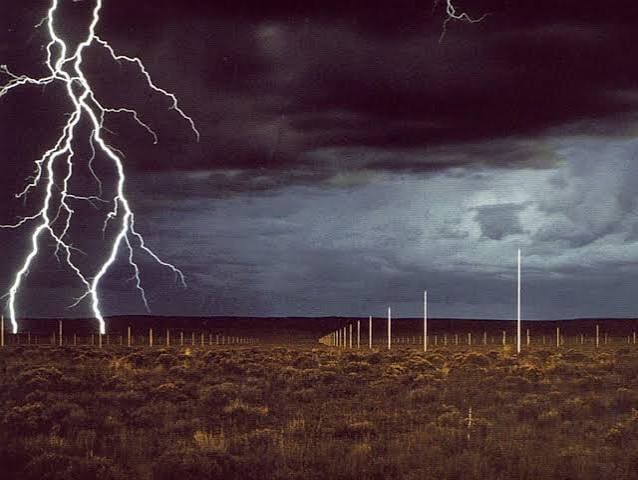
Land Art, thus, can be a means to provide a direct experience of an artist’s work that literally steps outside of usual life activities and time. The purchase of land plots surrounding The Lightening Field installation and the resultant conservation easements support an experience that is limited to a small number of privileged people. The location of the Lightening Field has ancestral ties to several Indigenous nations including Diné (Navajo), Apache, Zuni and Pueblo. The conservation easements preserve the art installation but preclude any land back to these Tribes.
A beautiful example of how an art organization and movement can help facilitate relationships between Indigenous peoples and their ancestral lands is the collaboration between the Osage Nation and the art and civil impact organization Counterpublic. Sugarloaf Mound is the last intact Osage burial mound in St Louis, Missouri. The Osage Nation started the rematriation process in 2023, with the help of Counterpublic. Rematriation is a term that emphasizes matrilineal societies and kinship with the earth for the process of land back and site recovery. Counterpublic supported the work of the Osage Nation on rematriation by installing a three-month long art exhibit on the Sugarloaf Mound site. The exhibit featured Native artists and included soundscapes, theatrical and storytelling performances as well as textile and painted works (PBS, 2024).
Walter De Maria’s Land Art provides a glimpse of how we can interact with nature differently than in everyday life. However, his work also includes a colonist and elitist perspective, in particular with the purchase of land parcels and conservation easements around the Lightening Field. The Osage Sugarloaf Mound collaboration with Counterpublic provides a stunning contrast to the land use that is more typical of the land art movement. In this blog, we will continue to share examples of how art can be created and installed in a manner that is both beneficial for the environment and the people who call that land home.
References