
The Potential For Carbon Sequestration with Polyculture
We now have data comparing baseline values at seeding to one year – from six residential sites and two institutional sites. The results far surpass what we had hoped for improvements in soil health after one year. In particular, the soil infiltration rate and depth to 300 PSI compaction have improved across the board, in some cases dramatically. For water resilience, this means that the rain falling on a site can actually remain onsite and infiltrate rather than running off.
It has been well-documented that soil organic carbon improves water holding capacity because the humus helps to build a soil sponge with the aggregates and pores that can hold water. The aggregate formation is due to soil microbes producing complex sugars such as glomalin that glue soil particles together as well as fungal hyphae (strands of fungi) that actually wrap soil particles. Our data shows improvements in both organic carbon as well as soil microbial biomass and other markers of soil microbes, providing evidence that the carbon and microbes are working together to build healthy soil.
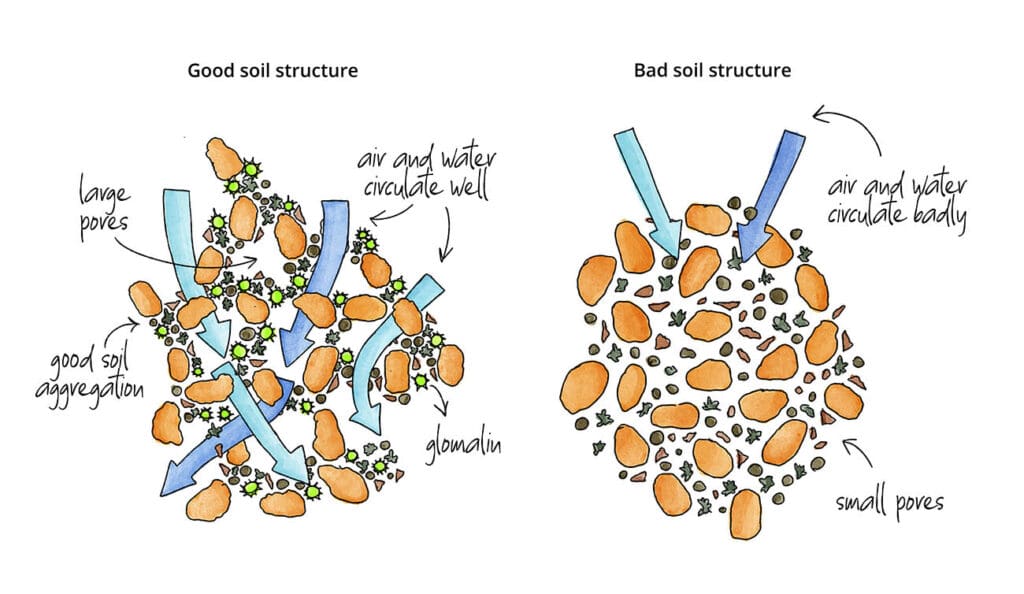
The diagram above shows good soil structure on the left versus bad soil structure on the right. Circulation of air (oxygen) and water is critical for good soil structure. Arbuscular mycorrhizal fungi (AMF) are found in most ecosystems and are associated with 80% of terrestrial plants. They produce the polysaccharide, glomalin, that acts as a bioglue to bind soil particles into aggregates as shown above (see Li et al, 2022). The soil microbiome, including fungi, bacteria and protozoa, relies on carbon from the plant roots in return for providing nutrients such as phosphorus and nitrogen as well as micronutrients including zinc, magnesium, calcium and copper (see Sound Agriculture, 2023).
Our data show that soil in natural land (from our local open space preserve at Penasquitos) has organic carbon from 6-12% while the best residential sites have from 3-4% organic carbon. From this, we infer that 5% organic carbon is an achievable goal with our polyculture approach.
In San Diego, the average residential lot is 6,500 square feet and the potential landscaped area is 20-50% of this total. Using 30% as a conservative value, the average lot has 2,000 square feet of potential landscaped area — which could become a polyculture meadow or an expanse of gravel with a few cacti (or worse). Based on the entire 2,000 square feet as a polyculture meadow with a typical bulk density (mass to volume ratio) of 1.3, and sampling using cores six inches deep with a hypothetical percent organic carbon of 5%, the amount of carbon per square foot works out to two pounds. This translates to potentially two TONS of carbon sequestered per residential lot — enough to drive a passenger car about 5,000 miles, or enough for one to two long-haul roundtrip flights such as London to New York. With an estimated 243,000 single family detached homes in San Diego, each with an average lot size of 6,500 square feet, that works out to nearly 500,000 tons of potential carbon sequestration!
Diverse polyculture lawns and meadows provide an opportunity to sequester a substantial amount of carbon to offset climate change. More importantly, these biodiverse habitats support a resilient soil microbiome which has been shown to be critical for drought and heat resilience. A recent paper (see Romero, 2025) notes that the soil microbiome is an indicator for ecosystem multifunctionality including nutrient cycling, water holding capacity, and primary production (photosynthesis).
There is a widespread perception that simply increasing organic matter in soil is both sufficient and necessary to increase water holding capacity. The California Compost Coalition (CCC) is a lobbying coalition that was created by a group of compost operators with a vision to increase awareness and preference for composting. The conversion of green waste into high quality compost is without question highly beneficial and part of the overall goal of keeping both water and any plant clippings on site where they can be reused. However, the soil aggregate formation described above requires the interaction with soil microbes and living roots and is incomplete with organic amendments alone.
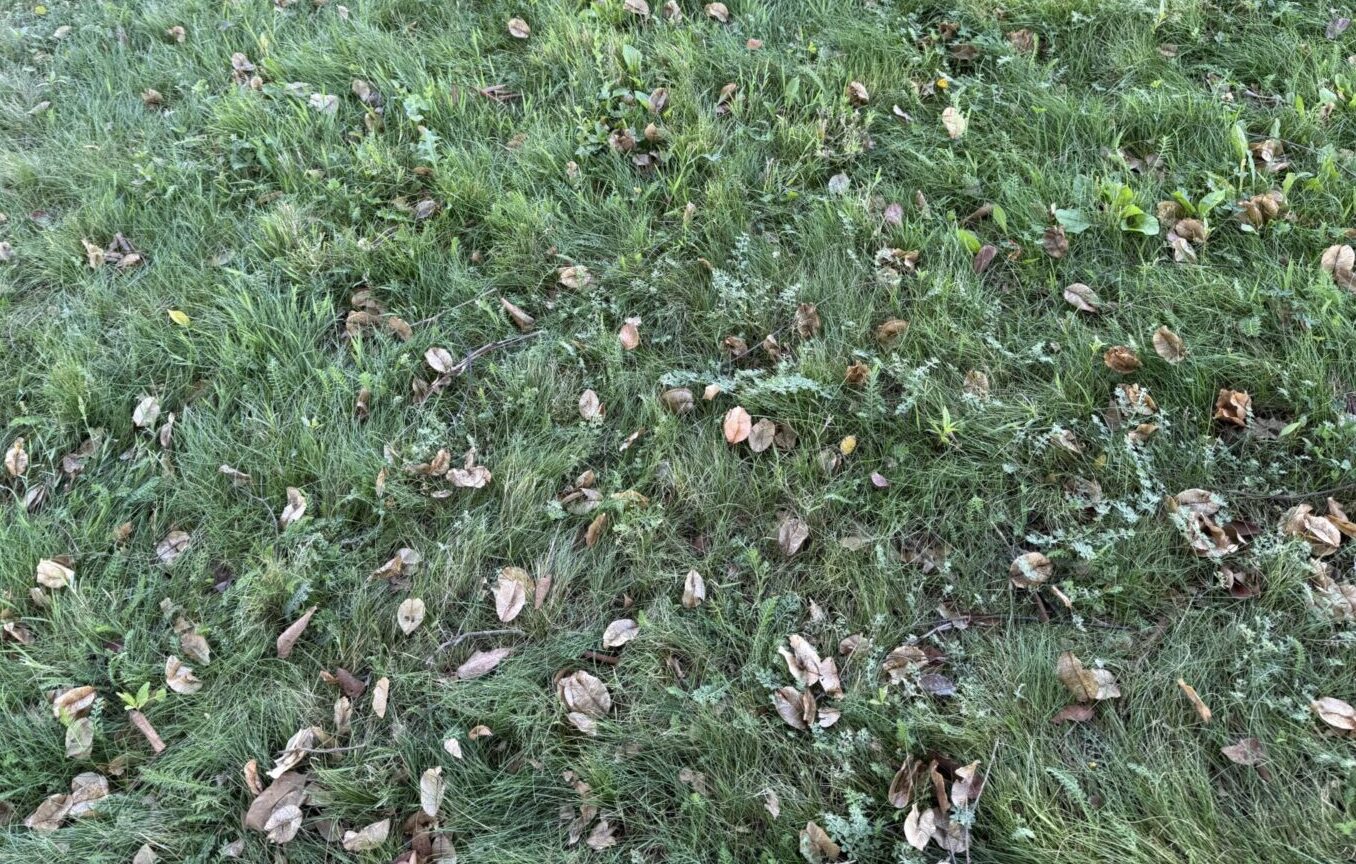
We are currently working on our “mowable mix” which includes native grasses, legumes, and wild flowers – which can be maintained at four – six inches for a “flower lawn”. The featured image shows our mix at a high school in San Juan Capistrano and we have several other sites that we are monitoring with this mix.
Reach out if you are interested – we are eager to sequester more carbon and create more beautiful spaces in San Diego!
References