
Flushing Toilets with Rainwater!
At our dojo, Aikido of San Diego, we train in the art of aikido: a martial art which is a fully embodied practice to empower your capacities for working with change, challenge, and conflict. Our dojo is located in a commercial building with a large roof area, which means that when it rains there could be a lot of runoff which wastes valuable water and can contribute to our beach closures due to the pollutants that can be collected into the water as it flows down the streets. Notice that I use the word “could” because in this case, we have installed two 530 gallon rainwater tanks to collect the roof rainwater.
The roof area that captures rainwater for the tanks is about 3,000 square feet which means that the two 530 gallon tanks can fill with only 0.6 inches of rain. There are two toilets plumbed to flush with rainwater, which use 1.2 gallons/flush. My rough estimate of 50 flushes per week with regular class attendance (more for seminars and special events) is 60 gallons, or about 3,120 gallons per year (52 weeks). We expect that the tanks will fill multiple times given that our rain events are often more than one inch over a weekend storm system.
Our system includes the following components going into the tanks: the two 530 gallon tanks already mentioned, which are connected with 2″ pipe, “leaf eater” filters at two downspouts with first flush diverters and a single supply line into the tanks, and overflow with a pop up emitter so the pipe is closed unless water is flowing
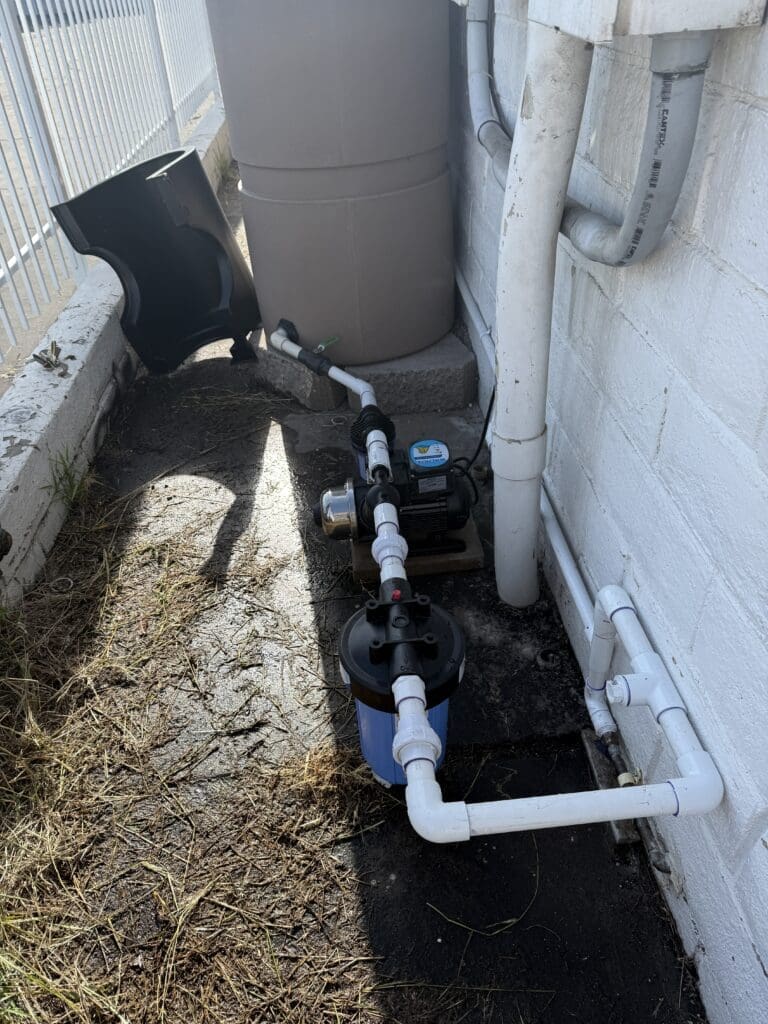
The distribution system to the toilets starts with a ball valve to allow water flow to a pre-pump 250 micron (coarse) filter, pump, wye filter with 100 micron, and a carbon filter. From here, the water splits between copper pipes to the two restrooms located on the other side of the wall from the tanks.

This system was a collaboration with my friends and colleagues at Catching H2O Inc, where I was formerly a partner before embarking on my current work with Dwelling On Carbon. I am very grateful to Brook Sarson, CEO at Catching H2O, and the entire team!
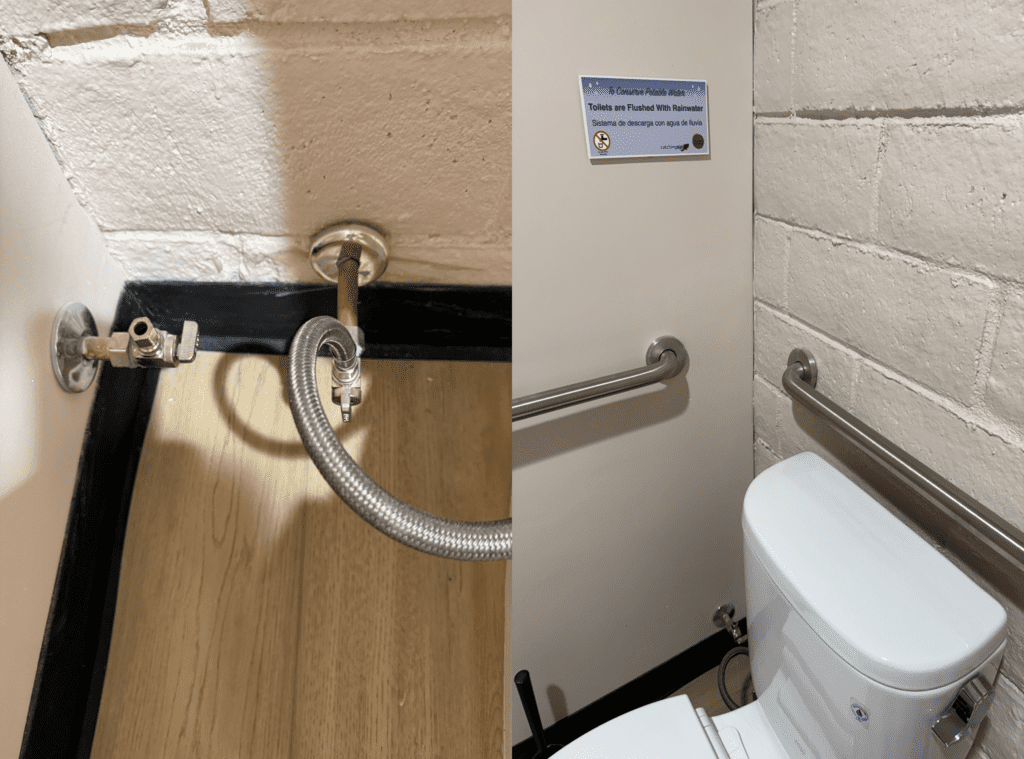
Inside the restrooms, we simply swapped the city water supply piping to the angle-stop valves at the toilets. On a regular basis, the water supply to the toilets is maintained with a dedicated city water “part-fill” mechanical valve with an air gap at the tanks to meet code requirements for no mixing of rainwater with potable water.
The photo on the left below shows the water source for the toilets coming from the rear of the building in the copper line from the rainwater pumped system – with the city water valve on the left. The photo on the right shows the toilet and the line to the angle-stop, with the signage about the rainwater visible on the wall.
There is so much opportunity to use rainwater for indoor use when there is no outside irrigation demand! We would love to see more rainwater usage in San Diego city and county both outdoors and indoors. Please reach out if you have an idea when this could work. All projects of this scale will be collaborations with Catching H2O!