

We may lose carbon satellites and endangerment finding
On July 24, Trump’s EPA announced that “greenhouse gases don’t endanger people”. This is a shocking and terrifying statement, though not surprising given that on the first day of his second term, Trump signed an executive order asking the EPA administrator to look into the legality and continuing applicability of the EPA’s endangerment finding.
EPA administrator, Lee Zeldin, is crafting a proposal to undo the government’s “endangerment finding”, which allows regulation of burning fossil fuels such as carbon dioxide and methane under the Clean Air Act. In March when this proposal was announced, Lee Zeldin said: “We are driving a dagger straight into the heart of the climate change religion to drive down the cost of living for American families, unleash American energy, bring back auto jobs to the U.S., and more”. Zeldin referred to this as “Power the Great American Comeback” (see EPA March, 2025).
It is hard to stomach that these words are coming from the EPA, which historically has been a bipartisan agency focussed on establishing regulations to address pollution and protect human health. The current EPA prioritizes economic growth and deregulation over environmental protection – which is extremely short-sighted.
The EPA’s endangerment finding originated from the Supreme Court’s April, 2007 decision in Massachusetts v. EPA that greenhouse gases are air pollutants covered by the Clean Air Act. The EPA Administrator signed two distinct findings in December, 2009:
- Endangerment finding: six well-mixed greenhouse gases in the atmosphere – carbon dioxide (CO2), methane (CH4), nitrous oxide N2O), hydrofluorocarbons (HFCs), perfluorocarbons (PFCs, and sulfur hexafluoride (SF6) – threaten the public health and welfare of current and future generations.
- Cause or contribute finding: the combined emissions of these greenhouse gases from new motor vehicles and their engines contribute to the emissions that threaten public health and welfare.
Interestingly, the auto industry is heading in the direction of more electric vehicles so the loss of the endangerment finding may not have the results desired by the Trump white house.
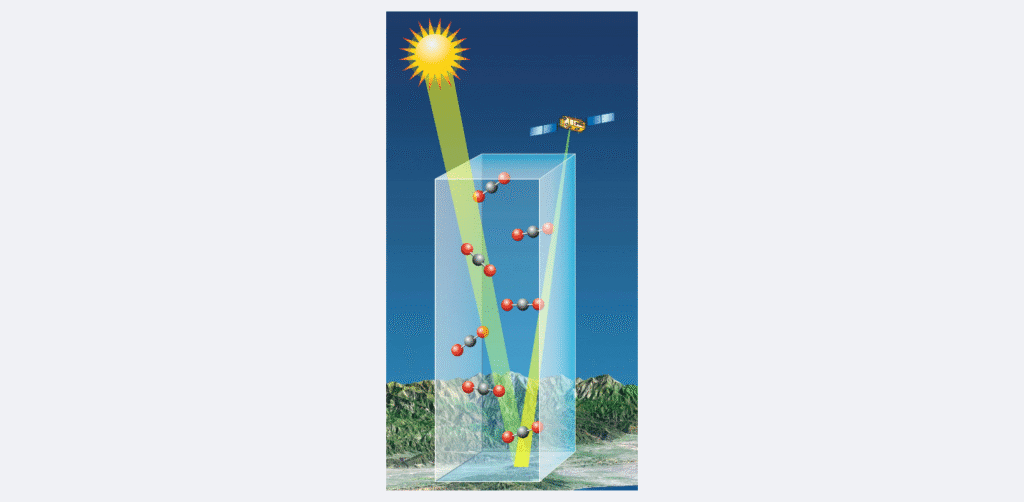
Along with the potential loss of the endangerment finding (and associated cause or contribute finding), the Trump administration is working to end at least two major satellite missions that monitor global carbon dioxide: orbiting carbon observatory (OCO)-2, a free-orbiting satellite, and OCO-3, which is attached to the International Space Station (Cartier, 2025). OCO-2 was placed into space by NASA in 2014 where it has been lapping the globe in a sun-synchronous orbit. OCO-2 measures CO2 by measuring the wavelengths of sunlight reflected off the earth’s surface (see figure below). The relative intensity reveals how much CO2 the sunlight passes through in the air column between the satellite and the ground (435 miles below). These measurements help scientists understand seasonal shifts in carbon sinks that affect how much of the 40 billion tons of carbon dioxide humans pump into the atmosphere annually are removed from the atmosphere into vegetation.
The loss of these satellites means the loss of tremendous potential to monitor the planet’s carbon cycle, support international climate agreements, and manage natural resources with predictions of crop yields, drought, and the health of marine ecosystems including the effectiveness of blue carbon projects — and so much more (Shutler, 2024). Luckily the rest of the world is not as short-sighted as we are as a country right now — other climate satellite programs include the European Space Agency as well as the Japanese green house gas monitoring satellite GOSAT-GW, launched in June of this year (see eoportal.org). These other projects do not replace the NASA satellites — the more we learn about the carbon cycle, the more we realize how little we really understand about it. This is particularly true for terrestrial ecosystems which have wildly different projections with “reasonably credible models”, according to David Schimel of the Jet Propulsion Lab. The new satellites are capable of filling tremendous gaps in our understanding and information such as the physical features of forests and the vapor loss from plant leaves. We need more of this detailed information, not less!!
References
CO2 Satellite Deconstructs Carbon Cycle
Shutler, (2024) The increasing importance of satellite observations to assess the ocean carbon sink and ocean acidification. Earth-Science Reviews 250, 104682
Tags: carbon sequestration